
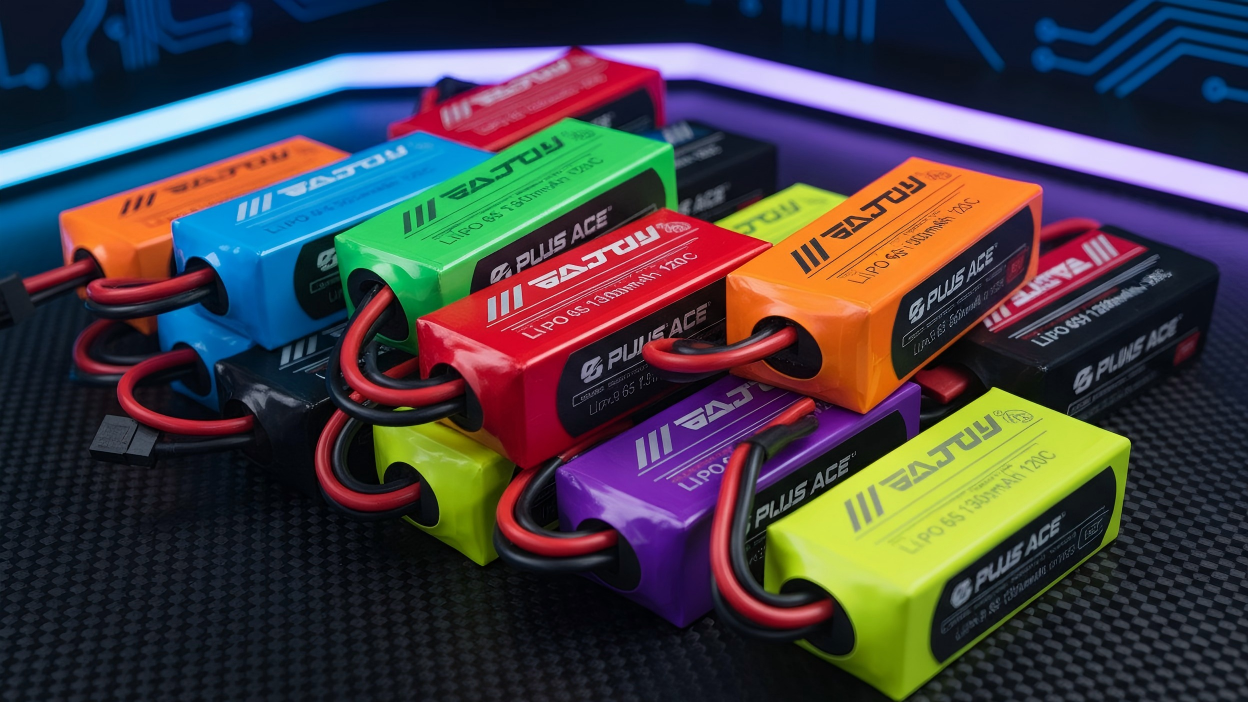
If you’ve ever flown an FPV drone, you know that the battery can make or break your flight experience. A drone’s battery doesn’t just provide power—it dictates flight time, weight, thrust, and even handling. Choosing the right battery requires understanding the different chemistries, capacities, voltages, and trade-offs.
Let’s discuss the three main battery types used in FPV drones: LiPo (Lithium Polymer), Li-ion (Lithium-ion), and LiHV (High Voltage Lithium Polymer). We’ll explore their characteristics, advantages, limitations, and ideal use cases, so you can make informed decisions for your FPV setup.

Fig. 1 Lipo Battery Comparison
Why FPV Battery Choice Matters
A battery is not only a power source; it impacts almost all the aspects of a drone's performance. While lighter batteries make a drone more agile, they will drain faster, putting additional stress on motors and decreasing flight time. High capacity batteries increase flight time but have more weight, making it harder for the drone to maneuver. The voltage and discharge rate of a battery impact throttle response and speed.
Choosing the right battery for FPV flights requires taking into account all these factors and choosing one that complements a particular drone model's size and requirements. Let us take a closer look at various battery types.

Fig. 2 FPV Lipo Batteries
1. LiPo Batteries: The FPV Standard
Lithium Polymer (LiPo) batteries have long been the go-to choice for FPV drones, particularly for racing, freestyle, and cinematic builds.
LiPo batteries are defined by several key characteristics that make them ideal for high-performance FPV flying.
|
Feature |
Typical Value / Description |
|
Nominal Voltage |
3.7 V per cell |
|
Capacity |
450–6,000 mAh |
|
C-Rating |
25–100C+ |
|
Weight |
Lightweight relative to energy output |
|
Electrolyte Type |
Polymer-based, flexible design |
There are several benefits associated with LiPos, which are the reasons why this type of battery has become popular among FPV drones. First of all, its high discharge rate ensures that it is easy to control the drone. Moreover, its light weight allows pilots to ensure that their drones are fast and maneuverable. Lastly, LiPo batteries come in flexible polymer packaging, thus allowing one to use them in any frame layout, including micro drones and 5-inch racing quads.
However, despite their numerous advantages, there are some disadvantages associated with LiPos. For instance, they must be stored properly; otherwise, they may suffer from swelling or even irreparable damage. This is due to the fact that this type of battery has limited cycle life (approximately 100–300 charge cycles).
2. Li-ion Batteries: Endurance and Efficiency
Lithium-ion (Li-ion) batteries have become increasingly popular in FPV drones that prioritize flight time and energy efficiency over raw power. While they cannot match LiPos for rapid bursts of throttle, Li-ion packs offer high energy density, long lifespan, and steady voltage output, making them ideal for endurance flying, cinematic drones, and micro builds.
Li-ion batteries differ from LiPos in construction and performance characteristics.
|
Feature |
Typical Value / Description |
|
Nominal Voltage |
3.6–3.7 V per cell |
|
Capacity |
1,500–5,000 mAh (or higher for long-range packs) |
|
C-Rating |
5–15C |
|
Weight |
Heavier than LiPo for equivalent energy |
|
Electrolyte Type |
Liquid electrolyte, rigid cell design |
The Li-ion batteries are highly favored due to the long cycle life, which may be as much as 500 to 1,000 charge cycles, thereby providing higher durability compared to the LiPo batteries. These batteries offer stable voltages when under load, thus offering smooth performance features and characteristics which can prove to be quite useful during film-making or when using drones in endurance events. The increased power output will allow flying time for extended periods without increasing the complexity of the drone.
Unfortunately, it should be noted that Li-ion batteries are not suitable for fast-paced FPV racing or freestyle since these batteries do not have the capacity to provide high current loads. Moreover, the fact that these batteries tend to be heavy can also make them unsuitable for smaller drones or for 5-inch racers.
3. LiHV Batteries: High Voltage for Peak Performance
High Voltage LiPo (LiHV) batteries take the familiar advantages of LiPo chemistry and push them further with a higher fully charged voltage per cell—4.35 V instead of the standard 4.2 V. This slight increase translates into higher energy density, reduced voltage sag, and improved overall performance, making LiHV packs an appealing choice for high-demand FPV applications.
LiHV batteries share many features with standard LiPos but are designed to handle higher voltages safely.
|
Feature |
Typical Value / Description |
|
Nominal Voltage |
3.7 V per cell (fully charged 4.35 V) |
|
Capacity |
1,300–1,800 mAh for 5-inch quads |
|
C-Rating |
50–100C+ |
|
Weight |
Slightly heavier than standard LiPo |
|
Electrolyte Type |
Polymer-based, high-voltage design |
LiHV batteries provide an increased capacity for storing energy without adding much bulk and therefore help minimize voltage drop during extreme flight maneuvers. This ensures that drones are able to maintain peak speeds for a prolonged period of time and fly for slightly longer than normal LiPos. They prove especially beneficial in 5-inch freestyle quadcopters and racing quads that need power and agility.
However, they are less accessible because special chargers have to be used for charging them, and their high voltage may damage other components of the drone if they are not monitored properly. LiHV batteries also tend to be quite costly when compared to standard LiPos.
Comparing LiPo, Li-ion, and LiHV Batteries
When deciding which battery type to use, it helps to compare key parameters side by side:
|
Feature |
LiPo |
Li-ion |
LiHV |
|
Voltage per cell |
3.7V nominal, 4.2V max |
3.6–3.7V nominal |
3.8V nominal, 4.35V max |
|
Max discharge rate (C) |
25–100C+ |
5–15C |
30–100C+ |
|
Energy density |
Medium |
High |
Medium-high |
|
Weight |
Light |
Medium-heavy |
Light-medium |
|
Cycle life |
100–300 |
500–1,000 |
150–400 |
|
Ideal use |
Racing, freestyle |
Endurance, cinewhoop |
High-performance racing, freestyle |
How to Choose the Right FPV Battery
Choosing a battery depends on drone type, flight style, and priority between performance and endurance. Here’s a practical guide:
Racing & Freestyle Drones: LiPo or LiHV packs are preferred due to high discharge rates and light weight. LiHV provides slightly more voltage and longer flight time.
Cinewhoops & Endurance Drones: Li-ion excels due to energy density and long cycle life, ideal for smooth, extended flights.
Small Micro Drones (Whoops, Tiny Drones): Li-ion or small LiPo packs can work, depending on the required weight and thrust balance.Budget Considerations: Standard LiPo batteries are the most widely available and affordable, while LiHV batteries offer higher performance at a slightly higher cost.
Tips for Safe Battery Use
1. Always use a compatible charger for your battery type.
2. Avoid deep discharges; store LiPo and LiHV packs at storage voltage (~3.8V per cell).
3. Check for puffing, swelling, or damage before each flight.
4. Balance-charge multi-cell packs regularly to ensure consistent performance.
Conclusion
Choosing the right FPV drone battery plays a crucial role in determining its flight capabilities and overall performance. Lithium-Polymer batteries are used mainly for race and freestyle drones because of their fast discharge rate and lightweight design. Lithium-Ion batteries are preferred for endurance and cinematography drones because of their long flight time and consistent performance. Lithium-Hybrid batteries are ideal for pilots looking to gain an edge in terms of speed and agility.


Leave a comment
This site is protected by hCaptcha and the hCaptcha Privacy Policy and Terms of Service apply.