
Introduction
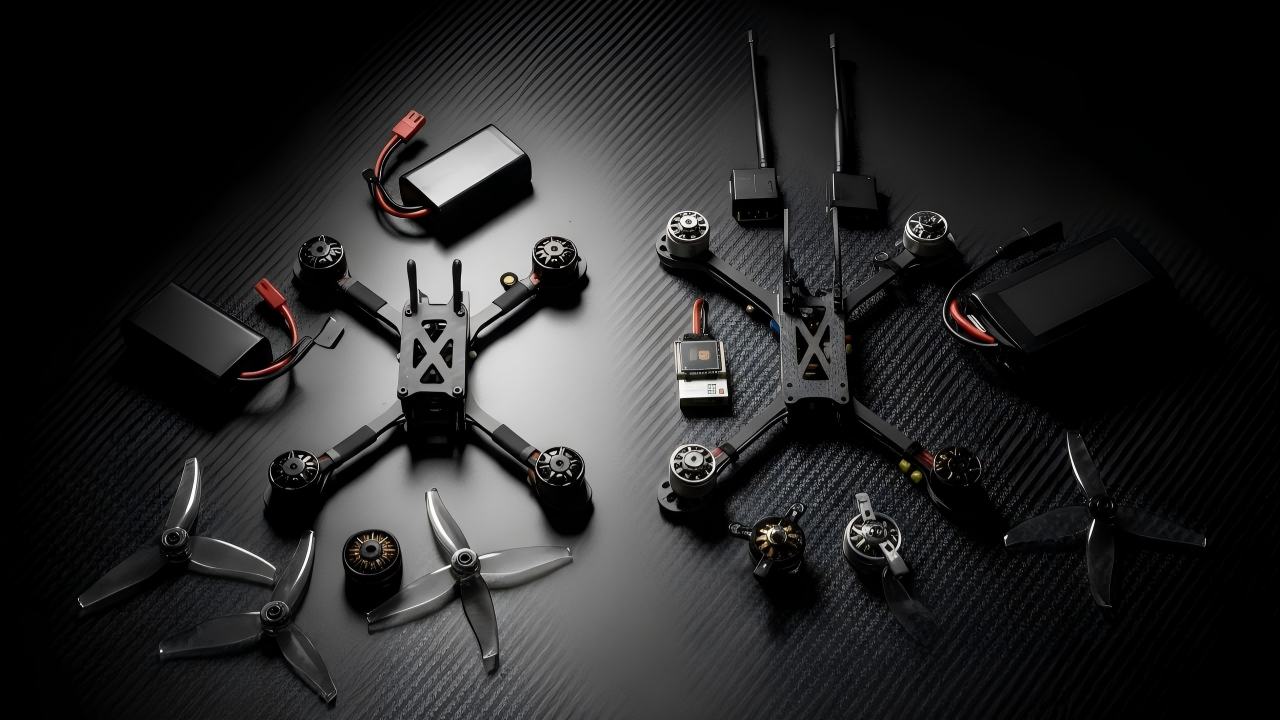
In FPV flight, not all drones are built to move the same way. Some are designed for instant responsiveness, flipping and diving at the slightest stick input, while others prioritize smooth, efficient flight to carry you farther with less effort.
These differences aren’t just cosmetic—they come down to four key areas: frames, motors, batteries, and flight modes. Understanding these distinctions helps you choose the setup that best fits your flying style.
1. Frames: Where the Personality Starts
The frame is the physical foundation of the drone, and it’s usually the first clue to what the build is meant to do.

Fig. 1 Droneer X501 Carbon Fiber FPV Frame
Freestyle Frames: Compact and Built to Take a Hit
Freestyle drones are most commonly built around 5-inch frames, using either true X or deadcat layouts. The focus here is not weight savings—it’s strength and balance.
With a typical wheelbase around 210–230mm and arm thickness in the 5–6mm carbon fiber range, these frames are designed to absorb impact. Replaceable arms are common, because repairs are expected, not avoided.
The geometry is kept tight and symmetrical so the drone behaves consistently in any direction. That matters when you’re flipping, rolling, or recovering from awkward angles.
In practice, this makes the drone feel:
- Tight and locked-in
- Highly responsive
- Comfortable flying close to obstacles
Because in freestyle, you’re not just near objects—you’re interacting with them.
Long-Range Frames: Stretched for Efficiency
Long-range frames move in a completely different direction. Instead of compact strength, they favor size, spacing, and efficiency.
Most builds fall into the 6-inch to 7-inch range, with wheelbases typically around 280–330mm or more. Arms are thinner and lighter, and the layout is often stretched to reduce prop wash and improve forward flight.
Deadcat designs are common here, not for style but for function—keeping props out of the camera view during long cruising shots.
You’ll also notice practical additions: mounts for GPS modules, larger antennas, and bigger batteries.
In the air, the difference is immediate. The drone tracks more smoothly, holds lines better, and feels far less twitchy. It’s not trying to react instantly—it’s trying to move efficiently and predictably.
2. Motors: How Power Is Delivered
Once the frame defines the structure, motors define how that structure behaves under input.

Fig. 2 Droneer X501 2207 Motor
Freestyle Motors: Fast and Punchy
Freestyle motors are selected for rapid response and high torque. Common sizes like 2207, 2306, or 2208, paired with 1700–2000KV on 6S, give the drone the ability to spin up quickly and recover just as fast.
That responsiveness shows up everywhere—in sharp direction changes, quick flips, and the ability to pull out of dives with authority.
The tradeoff is efficiency. These motors draw more power and generate more heat, especially under aggressive flying. But that’s expected. Freestyle isn’t about conserving energy—it’s about having it available instantly.
Long-Range Motors: Smooth and Efficient
Long-range motors are built with a different goal: doing more with less.
You’ll typically see larger stators like 2407, 2507, or 2806.5, combined with lower KV values in the 900–1500KV range. This setup reduces motor speed, lowers power draw, and improves efficiency over time.
Paired with larger props—usually 6 to 7 inches—these motors generate lift more easily without needing aggressive throttle input.
The result is a drone that feels:
- Smoother on throttle
- Less aggressive in response
- More stable over long distances
It’s not about power spikes—it’s about maintaining motion.
3. Batteries: What Limits Your Flight
If motors define how power is used, batteries define how long that power lasts.

Fig. 3 FPV Drone Battery
Freestyle Batteries: LiPo for Burst Performance
Freestyle drones rely on LiPo batteries, typically 4S or 6S with 1000–1500mAh capacity for 5-inch builds.
The key advantage is discharge rate. LiPo packs can deliver high current instantly, which supports aggressive throttle inputs and keeps voltage stable during demanding maneuvers.
The downside is short flight time—usually around 3 to 5 minutes. But that aligns with freestyle flying, which tends to be intense and short by nature.
Long-Range Batteries: Li-ion for Endurance
Long-range setups often switch to Li-ion batteries, usually in the 3000–4000mAh range or higher.
These batteries offer much higher energy density, which translates directly into longer flight times—often 10 to 30 minutes or more, depending on the setup.
The limitation is discharge rate. Li-ion packs don’t handle sudden, high-current demands well, which naturally discourages aggressive flying.
That’s why long-range flight feels smoother. The battery itself pushes you toward a more controlled, efficient style.
Some pilots mix both types—using LiPo for shorter cinematic flights and Li-ion for distance—but each battery clearly steers the drone toward a specific behavior.
4. Flight Modes and Tuning — How It Feels on the Sticks
Even with similar hardware, tuning changes everything.
Freestyle: Acro Mode with Aggressive Tuning
Freestyle is almost always flown in Acro (manual) mode, giving the pilot full control with no self-leveling.
Tuning tends to favor responsiveness: higher rates for faster rotation, sharper stick response, and minimal filtering to keep the connection between input and movement as direct as possible.
In the air, this creates a very immediate feeling. The drone reacts instantly, holds its line tightly, and feels “locked in” during maneuvers.
Long-Range: Stability with Built-in Safety
Long-range pilots also use Acro mode, but with a different mindset. Stability and predictability matter more than speed.
Lower rates are common, along with smoother response curves. Additional features like GPS rescue mode provide a safety net in case of signal loss, and some pilots use Angle mode during relaxed cruising.
The overall tuning aims to reduce oscillations and keep the drone behaving consistently over long flights.
In the air, it feels calmer—less reactive, more controlled, almost like gliding rather than constantly correcting.
Quick Comparison Table
|
Component |
Freestyle FPV |
Long-Range FPV |
|
Frame Size |
5-inch |
6–7 inch+ |
|
Wheelbase |
210–230mm |
280–330mm+ |
|
Frame Focus |
Durability |
Efficiency |
|
Motor Size |
2207 / 2306 / 2208 |
2407 / 2507 / 2806.5 |
|
Motor KV |
1700–2000KV |
900–1500KV |
|
Battery Type |
LiPo |
Li-ion |
|
Battery Capacity |
1000–1500mAh |
3000–4000mAh+ |
|
Flight Time |
3–5 min |
10–30+ min |
|
Flight Mode |
Acro (manual) |
Acro + GPS assist |
|
Flight Feel |
Fast, reactive |
Smooth, stable |
How to Choose
Freestyle and long-range FPV drones differ across frames, motors, batteries, and flight modes. Freestyle drones prioritize agility, responsiveness, and durability for short, intense flights, while long-range drones focus on efficiency, stability, and endurance for extended journeys.
Choosing the right FPV drone ultimately depends on your flying style and goals. If you crave rapid flips, tight maneuvers, and instant reactions, a freestyle setup is your ideal companion. For smooth, controlled flights over long distances, a long-range build will keep you gliding effortlessly. No matter which path you take, understanding these core differences ensures your drone performs exactly the way you want it to.

Leave a comment
This site is protected by hCaptcha and the hCaptcha Privacy Policy and Terms of Service apply.