
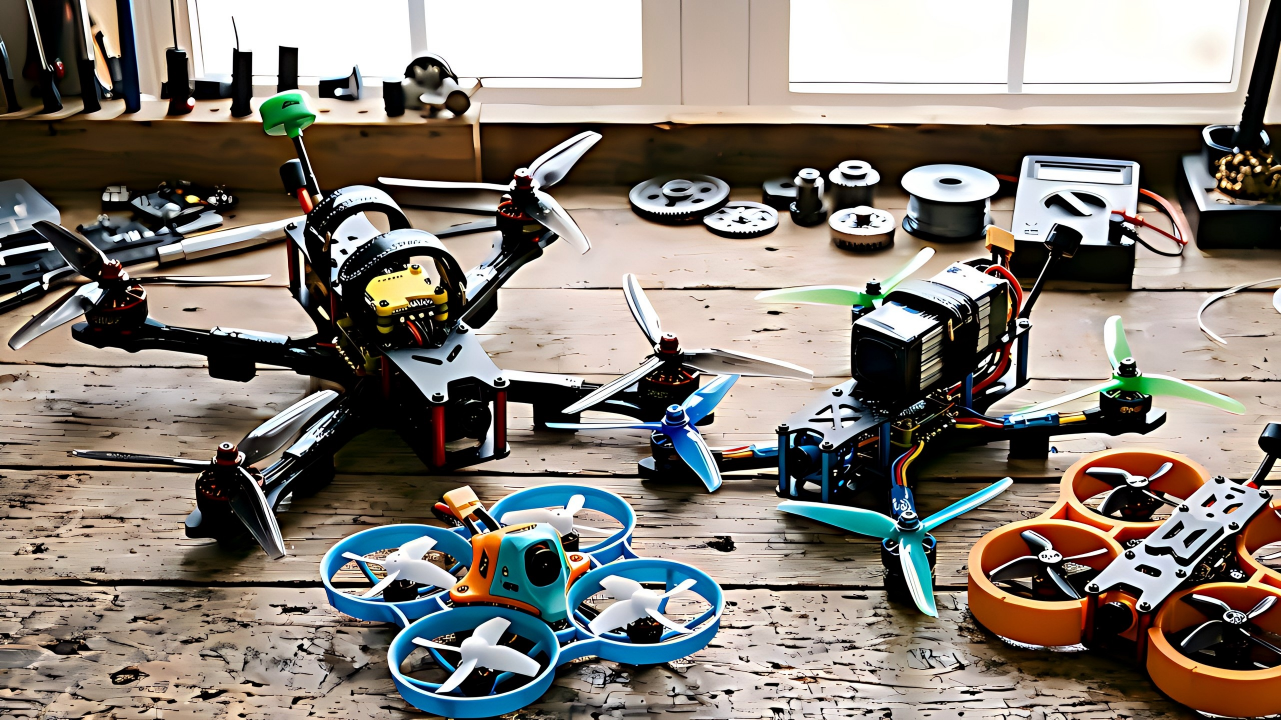
If you’re trying to choose an FPV drone, the biggest confusion usually isn’t specs—it’s which type actually fits how you want to fly. Different categories aren’t just size differences; they shape your entire experience, from control feel to crash risk to where you can fly.
Below is a clean, real-world breakdown of the main FPV drone types by size and use case.

Fig. 1 Types of FPV Drones
1. Tiny Whoop
Tiny Whoops are ultra-small, ducted FPV drones best for indoor flying, tight spaces, and absolute beginners.
Tiny Whoops typically use 65–85mm frames, 1S–2S batteries, and small brushed or brushless motors paired with ducted propellers. The ducts protect both the props and your surroundings, which is why these are considered the safest FPV drones to fly. Most setups include lightweight analog or digital FPV systems, and increasingly, compact HD recording options.
In terms of features, they prioritize low weight, simplicity, and durability. You’ll often see all-in-one flight controllers (AIO boards) combining ESC, FC, and receiver to keep weight down.
Pros:
- Extremely crash-resistant (bounce off walls)
- Safe for indoor use
- Low cost and easy to maintain
- Great for building stick time quickly
Cons:
- Very limited power, especially outdoors
- Struggle in wind
- Basic video quality (in most setups)
- Short flight times (typically 3–5 minutes)
2. Micro FPV (2–3 inch)
Micro FPV drones are small open-prop builds best for backyard flying, light freestyle, and transitioning from indoor to outdoor FPV.
These drones usually run 2–3 inch propellers, 2S–4S batteries, and lightweight brushless motors. Frames are compact but no longer ducted, which improves efficiency and responsiveness. Electronics are still often AIO-based, though more modular builds exist.
They strike a balance between portability and performance, offering a noticeable step up from Whoops without jumping into full-size builds. More responsive and agile than Whoops, with sharper control and better ability to handle outdoor conditions.
Pros:
- Good balance of power and size
- Suitable for smaller outdoor spaces
- More capable in wind than Whoops
- Entry point for freestyle tricks
Cons:
- Less durable than ducted drones
- Still limited compared to 5-inch performance
- Can feel like a “middle ground” you outgrow
3. Toothpick
Toothpick drones are ultra-lightweight micro FPV builds best for efficient cruising, smooth flying, and low-noise outdoor sessions.
Toothpicks use 2–3 inch props, but what sets them apart is their extremely low weight—often under 100g without battery. They run 2S–4S setups, minimal frames, and very lightweight components, including slim motors and stripped-down electronics.
There’s very little structural reinforcement—everything is optimized for efficiency and weight reduction. They feel floaty, smooth, and efficient, with less “punch” but more glide compared to heavier drones.
Pros:
- Excellent efficiency and flight time for size
- Quiet and unobtrusive
- Smooth, enjoyable cruising feel
- Lightweight = less damage in minor crashes
Cons:
- Fragile due to minimal structure
- Limited power for aggressive freestyle
- Less suited for carrying cameras
- Not beginner-proof despite small size
4. Cinewhoop
Cinewhoops are ducted FPV drones best for capturing smooth cinematic footage in tight indoor or controlled environments.

Fig. 2 Droneer C2501 Cinewhoop FPV Drone
Typically built with 2–3.5 inch props, 3S–6S batteries, and ducted frames, Cinewhoops are designed to carry action cameras like the GoPro HERO. They feature stronger motors than Whoops and tuned setups for stable, controlled flight.
They often include HD digital FPV systems and are optimized for video rather than agility. Cinewhoops feel stable, and controlled, prioritizing smooth lines over aggressive movement.
Pros:
- Safer for flying near people and objects
- Great for indoor and proximity filming
- Stable footage platform
- Widely used in commercial work
Cons:
- Reduced efficiency and flight time due to ducts
- Not ideal for wind
- Limited freestyle capability
- Heavier feel reduces responsiveness
5. Freestyle FPV (5-inch)
5-inch Droneer freestyle drones are the standard FPV platform best for acrobatics, creative flying, and all-around performance.

Fig. 3 Droneer X501 Freestyle FPV Drone
These drones usually run 5-inch props, 4S–6S batteries, and powerful brushless motors with separate ESCs and flight controllers. Frames are durable (often carbon fiber), designed to handle repeated crashes.
This category has the most developed ecosystem—parts, tuning presets, and community support. Freestyle drones are powerful, responsive, and aggressive, capable of flips, dives, and complex aerial maneuvers.
Pros:
- Strong power-to-weight ratio
- Highly versatile (freestyle, cinematic, general use)
- Huge parts availability and community support
- True “full FPV experience”
Cons:
- Higher crash damage risk
- Requires more space to fly
- Louder and more noticeable
- Steeper learning curve for beginners
6. Long Range FPV
Long range Droneer FPV drones are optimized for extended flight distance and efficiency, best for exploration and scenic cruising.
These builds typically use 5–7+ inch props, Li-ion or LiPo batteries, and efficient motors tuned for endurance rather than power. GPS modules, long-range radio systems, and reliable video links are essential components.
The focus is on system reliability and energy efficiency. Smooth, steady cruising, often at moderate speeds over long distances.
Pros:
- Long flight times (15–30+ minutes)
- Ideal for cinematic exploration
- Advanced features like GPS and return-to-home
- Efficient power usage
Cons:
- Requires planning and experience
- Not suited for aggressive flying
- Risk of losing the drone if something fails
- More complex setup and tuning
7. FPV Racing Drone
FPV racing drones are lightweight, high-speed builds best for competitive racing and maximum acceleration.
Usually based on 5-inch props, these drones use lightweight frames, high-KV motors, and minimal components to reduce weight. Everything is optimized for speed and responsiveness.
Durability is sacrificed for performance. Flight style is extremely fast, precise, and reactive, designed for tight race tracks and rapid directional changes.
Pros:
- Maximum speed and acceleration
- Highly responsive control
- Ideal for competitive environments
- Sharp, precise handling
Cons:
- Fragile compared to freestyle builds
- Limited use outside racing
- Demands high pilot skill
- Frequent repairs expected
8. Cinelifter (Heavy Lift FPV)
Cinelifters are large, heavy-lift FPV drones best for carrying professional cinema cameras in high-end film production.
These drones typically use 6–9+ inch props, often in X8 configurations (8 motors), and run high-capacity batteries. They are built to carry cameras like the RED Komodo 6K, along with stabilization and mounting systems.
They require advanced electronics, redundant systems, and precise tuning.
Pros:
- Professional-level image quality capability
- Can carry full cinema camera setups
- Used in films, commercials, and high-end productions
- Extremely stable under load
Cons:
- Very expensive (drone + camera)
- High risk in crashes
- Requires experienced pilots and often a team
- Complex setup and maintenance
Quick Comparison Table
|
Type |
Typical Size |
Best Use |
Flight Style |
Skill Level |
|
Tiny Whoop |
65–85mm (1S–2S) |
Indoor flying, tight spaces, beginners |
Slow, stable, floaty |
Beginner |
|
Micro FPV (2–3") |
2–3 inch props (2S–4S) |
Backyard flying, light freestyle |
Agile, responsive |
Beginner–Intermediate |
|
Toothpick |
2–3 inch (ultra-light) |
Efficient outdoor cruising, light freestyle |
Smooth, floaty, efficient |
Beginner–Intermediate |
|
Cinewhoop |
2–3.5 inch (ducted) |
Cinematic indoor/outdoor |
Smooth, controlled, stable |
Intermediate |
|
Freestyle FPV |
5 inch (4S–6S) |
Tricks, acrobatics, general FPV |
Aggressive, powerful |
Intermediate–Advanced |
|
Long Range FPV |
5–7+ inch (Li-ion capable) |
Exploration, mountain surfing |
Efficient cruising |
Advanced |
|
FPV Racing Drone |
5 inch (lightweight) |
Racing tracks, competition |
Ultra-fast, high thrust |
Advanced |
|
Cinelifter (X8 Heavy Lift) |
6–9+ inch (8 motors) |
Carrying cinema cameras (e.g. RED Komodo 6K) |
Stable, heavy, precise |
Professional |
How to Choose
Each FPV drone type represents a different balance of power, safety, efficiency, and purpose. There’s no single “best” option—only what fits your goals.
- Start with a Tiny Whoop if you want fast, low-risk learning
- Move to Micro FPV or Toothpick for outdoor confidence
- Choose Freestyle (5-inch) when you’re ready for full power
- Go Cinewhoop if your goal is video
- Explore Long Range once you understand systems and safety

Leave a comment
This site is protected by hCaptcha and the hCaptcha Privacy Policy and Terms of Service apply.