
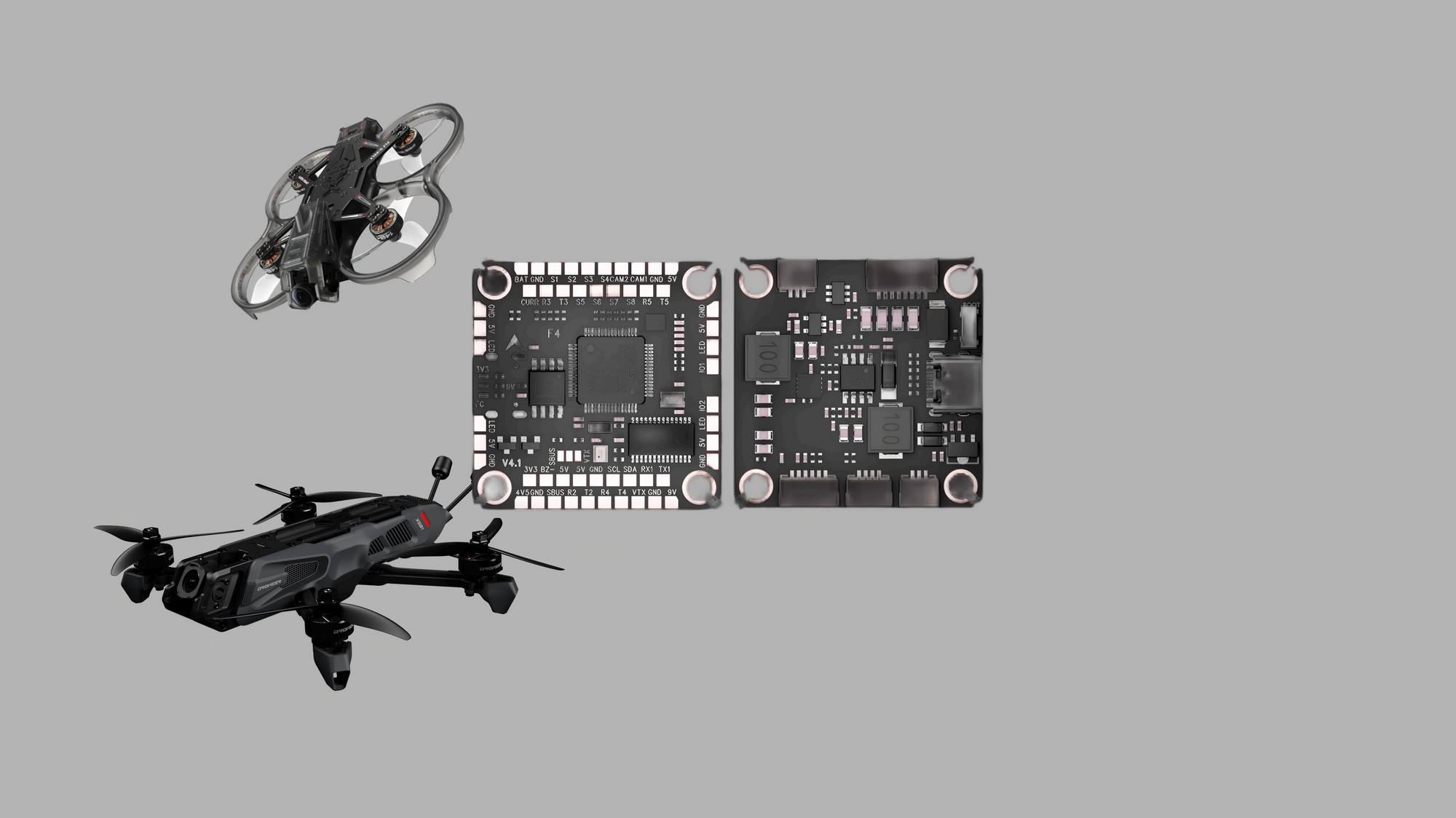
When building an FPV drone, one of the most important choices is the flight controller (FC). It acts as the brain of your drone, stabilizing flight, processing sensor data, and running the firmware that interprets your stick movements. For FPV pilots, the right FC can mean the difference between smooth, responsive flight and a frustratingly unsteady experience. Among the most widely used FCs today are the F4, F7, and H7, each offering different levels of performance, features, and suitability for various FPV drone builds—from beginner-friendly quads to professional racing and cinematic drones.
This guide walks you through F4, F7, and H7 flight controllers, their advantages and limitations, popular model numbers, key features, and how to choose the right one for your FPV drone.
What Is an FPV Flight Controller?
A flight controller is the central hub of an FPV drone. It reads data from gyroscopes, accelerometers, barometers, and other sensors, then executes the flight algorithms that keep your drone stable and responsive. Essentially, it translates pilot inputs into precise motor commands.
For FPV drones, having a capable flight controller is especially important. Racing, freestyle tricks, and cinematic maneuvers all demand fast, real-time adjustments. Modern FCs also integrate features like On-Screen Display (OSD), blackbox logging for analyzing flight data, and multiple UART ports for connecting GPS, telemetry, or other peripherals.
The processor on the flight controller—F4, F7, or H7—largely determines its performance. Faster processors allow higher gyro update rates, smoother PID loops, and advanced filtering, giving pilots the responsiveness they need for competitive racing or precise freestyle flying.

Fig. 1 FPV Flight Controller Comparison
F4 Flight Controller
F4 flight controllers can be classified as entry-level or mid-range products that use the STM32F4 processor. They offer adequate performance capabilities for most regular FPV drone assemblies and are perfect for novices or small quadcopters.
The main features of F4 flight controllers include their low weight, moderate price, and stability, making them suitable for 3S/4S assemblies or beginner freestyle drones. They are relatively simple to program and work well for regular FPV flights. Nonetheless, there are certain drawbacks associated with F4 FCs. Firstly, they generally lack UART ports, restricting the number of available peripherals, and their relatively slow processors might not work effectively with fast gyro updates or complex filters.
Popular Models include:
- F405: Compact, beginner-friendly, often includes basic OSD.
- F411: Lightweight, ideal for micro quads or small freestyle builds.
- F427: Higher-end F4 with more UARTs, supporting 5-inch quads.
F4 controllers remain a solid choice for new pilots or lightweight FPV drones.
F7 Flight Controller
The F7 flight controllers have the STM32F7 chip, which provides increased processing capabilities, additional UART ports, and improved gyro rate. These flight controllers are ideal for quads from 4S to 6S and pilots who want better responsiveness and performance.
The F7 FCs outperform their competitors in extreme freestyle, high-speed racing, and advanced functions such as dynamic filtering and Blackbox logging. They offer support for additional peripherals and higher refresh rates, which result in enhanced control. However, some downsides include relatively expensive prices and complicated configuration. Smaller quads might not make full use of the increased computing capabilities, while novice users might require more time for proper configuration.
Popular Types are:
- F722: Supports multiple UARTs and high gyro update rates, perfect for mid-sized FPV drones.
- F745: Offers integrated OSD and advanced logging for more detailed flight analysis.
- F777: Premium F7 with extended peripheral support, ideal for 5–6 inch freestyle builds.
F7 controllers are versatile, bridging the gap between beginner-friendly F4 and professional H7 options.

Fig. 2 AIO Flight Controller
H7 Flight Controller
The H7 flight controllers are equipped with the STM32H7 processor, providing the best performance possible. They are meant for high-end FPV setups such as 6S races, freestyle flying, and cinematography drones.
H7 FCs can manage extremely high gyro update rates, advanced filtering algorithms, and peripheral devices without any delays. The H7 FCs are future-proof and ideal for pilots who want the most responsive and accurate controls possible. Disadvantages include the increased price and complicated installation process.
Here are the Popular Models:
- H743: High-performance FC for 6S builds and cinematic FPV drones.
- H747: Supports multiple OSD, Blackbox, and telemetry options.
- H750: Top-tier H7 for professional freestyle or racing with large quads.
H7 controllers are best suited for pilots who want the ultimate performance and flexibility.
Features of Popular FPV Flight Controllers
|
Feature |
F411 |
F722 |
H743 |
|
Processor |
STM32F4 |
STM32F7 |
STM32H7 |
|
Max Gyro Update Rate |
8kHz |
32kHz |
32kHz+ |
|
UART Ports |
3 |
6 |
8+ |
|
Blackbox Logging |
Basic |
Advanced |
High-speed, advanced logging |
|
OSD Support |
Yes |
Yes |
Yes, multiple overlays |
|
Ideal FPV Drone |
3–4S freestyle, beginner-friendly |
4–6S freestyle or racing |
6S builds, cinematic, professional racing |
|
Firmware Compatibility |
Betaflight, iNav |
Betaflight, iNav |
Betaflight, iNav, ArduPilot |
|
Peripheral Support |
Basic |
Moderate |
Extensive (GPS, telemetry, sensors) |
|
Weight & Power Consumption |
Light, low |
Moderate |
Higher, optimized for high performance |
How to Choose
The selection of an appropriate flight controller will depend upon several factors including your flying objective, drone size, and experience level. As a beginner or one who builds a small quad, F4 flight controllers can do just fine and will be sufficient for most of the purposes at an economical price. F7 flight controllers are better for mid-sized quads that perform freestyle and racing flights. If you need a professional-level freestyle, cinematic flight or 6S flight controller, then H7 is highly recommended.
Some other factors include how many UART interfaces are needed to connect external devices to the flight controller. It should also have the capability to incorporate Blackbox or onboard screen display function. Finally, consider your flying style such as aggressive racing or aerial tricks and decide whether it needs a high performance flight controller with fast processor.
Conclusion
Each of the FCs has its own place within the field of FPV drones. The F4 is dependable and easy to use while also being very suitable for light builds. The F7 is versatile in performance, connectivity, and capabilities, which makes it ideal for medium-level pilots and above. The H7, on the other hand, comes with premium quality processing and versatility. The difference between the three types will help FPV pilots choose an FC that will go well with their build and flying ability.

Leave a comment
This site is protected by hCaptcha and the hCaptcha Privacy Policy and Terms of Service apply.